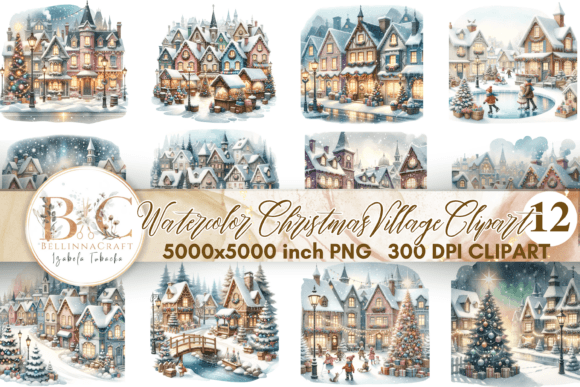
Reviewing Watercolor Christmas Village Clipart for Embroidery
As a designer who has spent years translating digital art into thread, I approach every new asset with a specific set of questions. Will this translate well to fabric? How will the stitch density affect the drape of the garment? Is the visual complexity too high for a standard home machine? When I first opened the Watercolor Christmas Village Clipart, my initial reaction was one of cautious optimism. The soft, blended edges typical of watercolor aesthetics can be notoriously difficult to replicate in embroidery, where hard lines and defined color blocks are the norm. However, looking past the digital preview, I began to visualize how these charming, snowy scenes could anchor a high-value holiday collection for my craft business.
The Visual Mood and Design Personality
The immediate appeal of this illustration lies in its nostalgic warmth. Unlike sharp, vector-style graphics that can sometimes feel cold or industrial, this design evokes the feeling of a hand-painted greeting card. For an embroidery project, this is both a strength and a challenge. The mood is cozy, inviting, and distinctly festive without being overly cluttered. The layout typically features clustered cottages, gentle snowdrifts, and perhaps a few bare trees or streetlamps. This composition suggests a narrative, which is excellent for storytelling on products like pillow covers or wall hangings.
From a technical standpoint, the "watercolor" effect implies gradient transitions. In the world of machine embroidery, we cannot simply print ink; we must simulate these gradients using thread colors. This means the design likely relies heavily on thoughtful color blending rather than complex stitch types alone. If you are an Etsy seller or small shop owner, this aesthetic aligns perfectly with the current trend toward soft, organic, and handmade-looking goods. It feels less like mass-produced merchandise and more like a personalized gift crafted with care.
Real-World Application: The Holiday Tote Bag Scenario
To test the viability of this design, I imagined a real-life scenario: creating a limited run of custom embroidered tote bags for a local boutique. The goal was to offer a premium holiday item that customers would use year after year. I placed the Watercolor Christmas Village Clipart centrally on a natural canvas tote. The result was striking. The rustic texture of the canvas complemented the soft edges of the village scene.
However, success here depended on execution. I knew that trying to stitch every tiny brushstroke would result in a dense, stiff patch that might distort the bag. Instead, I focused on simplifying the color palette. By selecting six to eight key thread colors that captured the essence of the watercolor washes—soft blues for shadows, warm creams for building walls, and muted greens for trees—I could maintain the artistic integrity while keeping the stitch count manageable. This approach ensures the finished product remains flexible and durable, crucial for a functional item like a tote bag design.
Best Uses for This Illustration
Based on its visual weight and detail level, this design shines in specific applications. It is ideal for:
- Sweatshirt embroidery: The larger surface area of a chest or back panel allows the details of the village to breathe without becoming lost.
- Pillow covers: Home decor items benefit from the static, framed nature of the scene, making it a focal point in living room styling.
- Kitchen towels and aprons: For a festive touch, placing a smaller version near the hem adds charm without interfering with functionality.
- Holiday gifts: Personalized ornaments or small patches make excellent add-ons for gift baskets.
Conversely, this design requires careful consideration when applied to curved surfaces like caps. The width of a typical village scene might exceed the standard cap hoop size, requiring significant resizing. If scaled down too much, the intricate details of the houses and trees could merge into an indistinct blob of thread. Therefore, I would advise against using this specific clipart for small embroidered patches unless the design is simplified significantly.
Technical Considerations for Stitching Clarity
When working with any digital embroidery file derived from illustrations, understanding stitch density is paramount. Watercolor effects often suggest softness, but if the digitizer uses too many fill stitches to mimic shading, the fabric can pucker. Before committing to a final production run, always test the design on scrap fabric identical to your final material. Check how the stabilizer interacts with the thread tension. A cut-away stabilizer is often recommended for knit fabrics like sweatshirts to prevent distortion, while a tear-away might suffice for woven cottons used in tote bags or tea towels.
Thread color contrast is another critical factor. On dark fabrics, the lighter tones of the watercolor village may pop beautifully, but you must ensure there is enough underlay stitching to prevent the fabric color from showing through. On light fabrics, the shadows need to be distinct enough to provide depth. I recommend running a black-and-white mockup test to verify that the design holds its shape and readability even without color information. If the details disappear in grayscale, the design may lack sufficient contrast for clear stitching.
Navigating Fabric and Washability
For items that require frequent washing, such as baby clothes or kitchen linens, the durability of the stitch work is non-negotiable. Dense areas in the village roofs or tree trunks should be checked for potential thread breakage or puckering after multiple wash cycles. Using high-quality polyester or rayon threads can enhance the sheen, mimicking the wet look of watercolor, but cotton threads may offer a more matte, rustic finish that suits the theme better. Always confirm the care instructions for your chosen thread and fabric combination to ensure longevity.
Commercial Viability and Brand Consistency
For creative entrepreneurs and commercial embroidery professionals, the licensing terms of any digital asset are crucial. Before selling finished products featuring the Watercolor Christmas Village Clipart, verify the license included with the download. Some assets are for personal use only, while others allow for commercial application. Assuming the license permits it, this design can significantly boost buyer engagement. Its unique aesthetic helps differentiate your small shop product from generic, clip-art-heavy competitors. It signals professionalism and attention to detail, fostering customer trust.
Moreover, this illustration serves as a versatile design asset for marketing. You can use it in printable mockups for your Etsy listings to show potential customers how the design looks on various products before they buy. This visual consistency across your brand’s digital presence and physical products strengthens recognition and appeal.
Final Designer Notes
In conclusion, the Watercolor Christmas Village Clipart is a strong contender for holiday-themed projects, provided it is handled with technical precision. It is not a plug-and-play solution for every fabric type or hoop size. Success lies in adaptation: simplifying colors, choosing the right stabilizer, and respecting the limitations of the embroidery machine. By treating the digital file as a starting point rather than a final command, you can create stunning, high-value handmade products that resonate with customers. Always check the specific file formats and compatibility with your machine software, and never skip the test stitch. With careful planning, this design can become a standout element in your seasonal collection.